Why Whole-Child Support Fails Without Daily Student Wellness Data
The Uncomfortable Truth: Your Data is Already Obsolete
Modern district leadership runs on data, not instinct alone. They track attendance, disciplinary referrals, standardized test scores, and credit recovery rates with surgical precision. But there’s an uncomfortable truth most administrators come to realize, usually when it’s already too late: Much of the data meant to support the “whole child” is outdated by the time it reaches decision-makers.
This reliance on “delayed snapshots” is a major factor in The #1 Reason SEL Programs Lack Consistency in Schools — And How to Fix It. When your insights are weeks or months behind, your implementation feels reactive rather than intentional. We treat student wellness data like a fossil, something to be dug up, cleaned off, and examined long after the organism has changed. By the time a leadership team reviews a quarterly climate report, the student who was “spiraling” in October has already checked out by December.
If your strategy for whole-child support relies on looking in the rearview mirror, you shouldn’t be surprised when you can’t navigate the road ahead. To support a child today, you need to understand how they are feeling today.
Respecting the Baseline, Challenging the Frequency
Annual climate surveys and pre/post-program assessments have a place. They are excellent for establishing a 30,000-foot baseline, helping boards of education see long-term growth, and justifying budget expenditures. They are useful lagging indicators.
However, lagging indicators tell you that the ship has already hit the iceberg. If we are serious about whole-child support, we need leading indicators.
An annual survey will never capture the specific micro-shifts in student wellness that dictate classroom behavior, academic focus, and school safety. When we collect data only twice a year, we miss the 178 days in between when the actual learning and the actual struggling happen. This data gap is precisely why Fixed SEL Scope and Sequences Fail in Real Classrooms; a rigid calendar cannot account for the Tuesday morning trauma or the Friday afternoon social isolation that real-time student voice would reveal.
The Shift from Post-Mortems to Pulse Checks
To help you visualize the difference between “Big Data” and “Actionable Insight,” here is a comparison of traditional methods versus a real-time wellness approach.
The "Check-the-Box" Compliance Trap
Why is most school data so disconnected from reality? Because we have fallen into the Compliance Trap. When data collection feels like a “chore” mandated by the state or a grant requirement, it loses its soul.
Students are incredibly perceptive; they know when a survey is authentic and when it is a “check-the-box” exercise. When a student is handed a 50-question bubble sheet once a semester, they don’t provide insight; they provide whatever answer gets them out of the room fastest.
Authentic data cannot be forced through a compliance lens. If the survey feels disconnected from the student’s real-time experience, the data you receive will be a reflection of their boredom, not their well-being. To get the truth, you have to ask the right questions, at the right time, in the right way.
What Does "Authentic Data" Actually Mean?
In the context of a high-functioning school, Authentic Data is defined by three pillars: Real-time, Simple, and Frequent. It isn’t a psychological deep-dive every morning; it’s a “pulse check.”
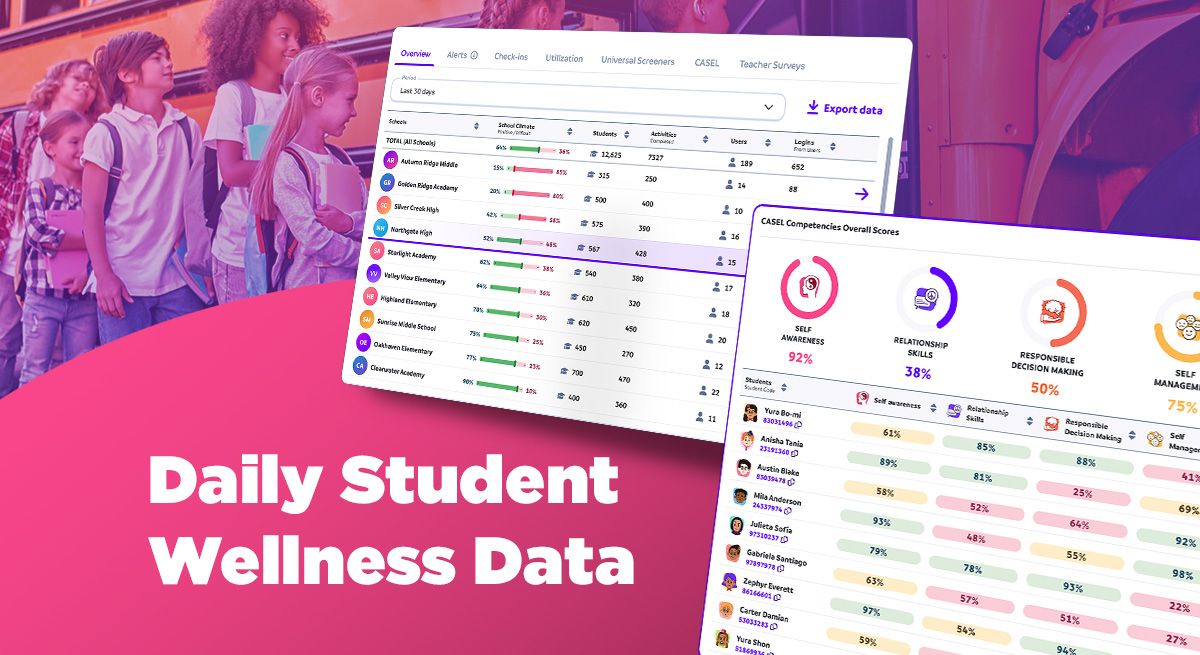
Imagine a dashboard that doesn’t just show you who was absent yesterday, but who is “emotionally absent” right now. Authentic data gives you a high-definition view of the whole child, moving beyond a static snapshot and into a living, breathing map of the school’s emotional climate. This is the difference between a “wellness report” and a “wellness reality.”
The School Climate Trends Dashboard
Imagine a dashboard that doesn’t just show you who was absent yesterday, but who is “emotionally absent” right now. Authentic data gives you a high-definition view of the whole child, moving beyond a static snapshot and into a living, breathing map of the school’s emotional climate. This is the difference between a “wellness report” and a “wellness reality.”
Prevention vs. Reaction: The Power of Patterns
The primary goal of any SEL or wellness initiative is prevention. We want to support the student before the behaviour leads to an office referral. We want to intervene before the disengagement leads to a failing grade. When you collect daily student wellness data, patterns emerge that are invisible to the naked eye.
Comparison: The MTSS Framework Data Shift
Seeing these patterns early allows for Proactive Intervention. When data is late, our responses are reactive. We find ourselves “putting out fires” instead of preventing the spark. Daily data turns educators from firefighters into architects of a safe environment.
Defending Teacher Capacity
We cannot talk about data without talking about the person tasked with collecting it: the teacher. Let’s be blunt: if capturing wellness data takes more than 60 seconds of instructional time, it won’t happen. If you force it, the data won’t be reliable because the teacher will view it as an obstacle to their “real work.”
This is where the Netflix-Style SEL Lesson: High Student Engagement with Zero Teacher Prep becomes essential. Data collection should be an invisible byproduct of student engagement. By integrating wellness checks into the daily digital routine, we protect teacher capacity while gaining invaluable insights. We aren’t adding a task; we are providing a tool that makes the teacher’s job easier by identifying learner variability before the lesson even starts.
Better Data, Better Decisions
Real-time insight changes the way a school operates at every level:
- The Teacher: Can adjust the “emotional volume” of the room based on the morning’s pulse check. If 40% of the class reports “high stress,” perhaps the high-stakes peer review can wait until tomorrow.
- The Counselor: Can prioritize their caseload based on who signaled a “red flag” today, rather than waiting for a crisis or a formal referral.
- The principal: Can understand school climate trends (e.g., “Is our 7th grade feeling disconnected after the assembly?”) without waiting for an end-of-year report.
Data-driven decision-making is only as good as the data itself. When your data is fresh, your decisions are relevant. When it’s stale, your decisions are merely guesses wrapped in a spreadsheet.
The Mic Drop: From Documentation to Intervention
Schools don’t need more data—they need better, timely data. We have spent enough time documenting student failure after the fact. It is time we start documenting student wellness in the moment.
If you truly care about the “whole child,” then their daily reality must matter more than your delayed results. You cannot manage what you do not measure, and you cannot measure a moving target with a still photograph.
Stop Guessing. Start Knowing.
Your students are telling you how they feel every day. Are you listening, or are you waiting for a survey? School Beat turns the daily pulse of your classroom into actionable insights, giving you the real-time data needed to support every student, every day.
[See How SchoolBeat Captures Real-Time Wellness Data →]
The Uncomfortable Truth: Your Data is Already Obsolete
Modern district leadership runs on data, not instinct alone. They track attendance, disciplinary referrals, standardized test scores, and credit recovery rates with surgical precision. But there’s an uncomfortable truth most administrators come to realize, usually when it’s already too late: Much of the data meant to support the “whole child” is outdated by the time it reaches decision-makers.
This reliance on “delayed snapshots” is a major factor in The #1 Reason SEL Programs Lack Consistency in Schools — And How to Fix It. When your insights are weeks or months behind, your implementation feels reactive rather than intentional. We treat student wellness data like a fossil, something to be dug up, cleaned off, and examined long after the organism has changed. By the time a leadership team reviews a quarterly climate report, the student who was “spiraling” in October has already checked out by December.
If your strategy for whole-child support relies on looking in the rearview mirror, you shouldn’t be surprised when you can’t navigate the road ahead. To support a child today, you need to understand how they are feeling today.
Respecting the Baseline, Challenging the Frequency
Annual climate surveys and pre/post-program assessments have a place. They are excellent for establishing a 30,000-foot baseline, helping boards of education see long-term growth, and justifying budget expenditures. They are useful lagging indicators.
However, lagging indicators tell you that the ship has already hit the iceberg. If we are serious about whole-child support, we need leading indicators.
An annual survey will never capture the specific micro-shifts in student wellness that dictate classroom behavior, academic focus, and school safety. When we collect data only twice a year, we miss the 178 days in between when the actual learning and the actual struggling happen. This data gap is precisely why Fixed SEL Scope and Sequences Fail in Real Classrooms; a rigid calendar cannot account for the Tuesday morning trauma or the Friday afternoon social isolation that real-time student voice would reveal.
The Shift from Post-Mortems to Pulse Checks
To help you visualize the difference between “Big Data” and “Actionable Insight,” here is a comparison of traditional methods versus a real-time wellness approach.
The "Check-the-Box" Compliance Trap
Why is most school data so disconnected from reality? Because we have fallen into the Compliance Trap. When data collection feels like a “chore” mandated by the state or a grant requirement, it loses its soul.
Students are incredibly perceptive; they know when a survey is authentic and when it is a “check-the-box” exercise. When a student is handed a 50-question bubble sheet once a semester, they don’t provide insight; they provide whatever answer gets them out of the room fastest.
Authentic data cannot be forced through a compliance lens. If the survey feels disconnected from the student’s real-time experience, the data you receive will be a reflection of their boredom, not their well-being. To get the truth, you have to ask the right questions, at the right time, in the right way.
What Does "Authentic Data" Actually Mean?
In the context of a high-functioning school, Authentic Data is defined by three pillars: Real-time, Simple, and Frequent. It isn’t a psychological deep-dive every morning; it’s a “pulse check.”
Imagine a dashboard that doesn’t just show you who was absent yesterday, but who is “emotionally absent” right now. Authentic data gives you a high-definition view of the whole child, moving beyond a static snapshot and into a living, breathing map of the school’s emotional climate. This is the difference between a “wellness report” and a “wellness reality.”
The School Climate Trends Dashboard
Imagine a dashboard that doesn’t just show you who was absent yesterday, but who is “emotionally absent” right now. Authentic data gives you a high-definition view of the whole child, moving beyond a static snapshot and into a living, breathing map of the school’s emotional climate. This is the difference between a “wellness report” and a “wellness reality.”
Prevention vs. Reaction: The Power of Patterns
The primary goal of any SEL or wellness initiative is prevention. We want to support the student before the behaviour leads to an office referral. We want to intervene before the disengagement leads to a failing grade. When you collect daily student wellness data, patterns emerge that are invisible to the naked eye.
Comparison: The MTSS Framework Data Shift
Seeing these patterns early allows for Proactive Intervention. When data is late, our responses are reactive. We find ourselves “putting out fires” instead of preventing the spark. Daily data turns educators from firefighters into architects of a safe environment.
Defending Teacher Capacity
We cannot talk about data without talking about the person tasked with collecting it: the teacher. Let’s be blunt: if capturing wellness data takes more than 60 seconds of instructional time, it won’t happen. If you force it, the data won’t be reliable because the teacher will view it as an obstacle to their “real work.”
This is where the Netflix-Style SEL Lesson: High Student Engagement with Zero Teacher Prep becomes essential. Data collection should be an invisible byproduct of student engagement. By integrating wellness checks into the daily digital routine, we protect teacher capacity while gaining invaluable insights. We aren’t adding a task; we are providing a tool that makes the teacher’s job easier by identifying learner variability before the lesson even starts.
Better Data, Better Decisions
Real-time insight changes the way a school operates at every level:
- The Teacher: Can adjust the “emotional volume” of the room based on the morning’s pulse check. If 40% of the class reports “high stress,” perhaps the high-stakes peer review can wait until tomorrow.
- The Counselor: Can prioritize their caseload based on who signaled a “red flag” today, rather than waiting for a crisis or a formal referral.
- The principal: Can understand school climate trends (e.g., “Is our 7th grade feeling disconnected after the assembly?”) without waiting for an end-of-year report.
Data-driven decision-making is only as good as the data itself. When your data is fresh, your decisions are relevant. When it’s stale, your decisions are merely guesses wrapped in a spreadsheet.
The Mic Drop: From Documentation to Intervention
Schools don’t need more data—they need better, timely data. We have spent enough time documenting student failure after the fact. It is time we start documenting student wellness in the moment.
If you truly care about the “whole child,” then their daily reality must matter more than your delayed results. You cannot manage what you do not measure, and you cannot measure a moving target with a still photograph.
Stop Guessing. Start Knowing.
Your students are telling you how they feel every day. Are you listening, or are you waiting for a survey? School Beat turns the daily pulse of your classroom into actionable insights, giving you the real-time data needed to support every student, every day.
[See How SchoolBeat Captures Real-Time Wellness Data →]