What Real-Time, Authentic Wellness Data in One Place Means for a School District.
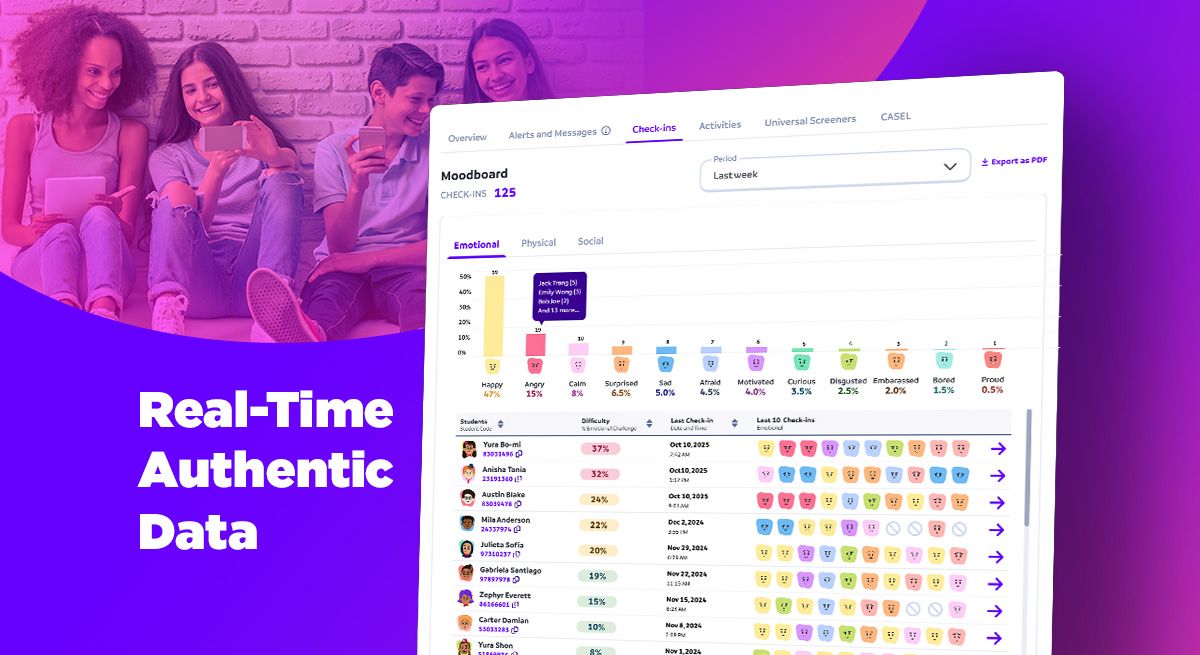
For most district leaders, the ‘state of student wellness’ is retrospective. It is a series of spreadsheets compiled at the end of a semester, a biennial climate survey with a 40% response rate, or most tragically, a spike in disciplinary referrals and crisis interventions that tells you what went wrong three months ago.”
In the modern K-12 landscape, delayed data is dead data.
District leaders are currently navigating a mental health crisis with tools designed for compliance, not for pulse-taking. According to CDC data, nearly 40% of high school students reported persistent feelings of sadness or hopelessness in the past year, yet many schools only identify these students once they reach a breaking point. When wellness data is fragmented or delayed, equity gaps widen, and educators burn out trying to play catch-up.
Moving toward real-time student wellness data isn’t just a technical upgrade; it is a fundamental shift in district operations. It is the difference between documenting a student’s failure and preventing it from happening.
Why Districts Are Flying Blind
The current standard for student wellness tracking relies on “lagging indicators.” Districts typically wait for three data points to trigger help:
- Attendance: By the time a student is chronically absent, the disconnect has already happened.
- Discipline: Behavioral blowouts are the final stage of an unaddressed internal struggle.
- Grades: Academic decline is often the last domino to fall.
When you rely on these, you aren’t practicing early intervention; you are performing an autopsy. Research from Branching Minds suggests that a proactive MTSS (Multi-Tiered System of Supports) requires ongoing problem-solving where students are assessed frequently enough to catch “silent” signals before they become crises.
The Power of Real-Time vs. Historical Reports
There is a common misconception in EdTech that more data is better. District leaders don’t need more data; they need better timing.
Historical reports are for board meetings and state compliance. They tell you how many students felt “unsafe” or “unsupported” last year. While helpful for long-term budgeting, they do nothing for the student sitting in a third-period math class today who is experiencing a crisis of belonging.
Real-time signals change the behavior of the system.
- Historical: “Our SEL program didn’t seem to impact 8th-grade anxiety levels last year.”
- Real-Time: “We are seeing a 15% dip in 8th-grade ‘sense of belonging’ across three middle schools this week. Let’s adjust our Tier 1 support now.”
What "Authentic" Wellness Data Actually Means
To be useful, data must be authentic. For years, student wellness analytics have been skewed by “performative data” surveys that are too long or too infrequent. Authentic data is built on:
- Student Voice: Short, frequent, and low-friction touchpoints where students feel heard, not interrogated.
- Daily Signals: Capturing the “micro-moments” of a student’s experience.
- Context: Understanding that wellness fluctuates. A student might be thriving on Tuesday and struggling on Friday.
The National Alliance on Mental Illness (NAMI) emphasizes that early identification is the key to preventing long-term mental health challenges. By gathering these daily signals into a centralized Report Section, administrators can see the pulse of their entire district without adding friction to the school day.
The Value of One Centralized Ecosystem
The “dashboard fatigue” felt by principals and superintendents is real. The solution isn’t another tool; it’s the consolidation of existing insights into one place. When wellness data is centralized, it provides three distinct levels of visibility:
- The District-Level View: Patterns and Equity
Centralized data allows superintendents to see if a specific initiative is working across the board or only in affluent pockets. This allows for smarter resource allocation, sending support staff where they are actually needed today rather than where they were needed last semester.
- The School-Level View: Trends and Climate
Principals can use a centralized Report Section to monitor building climate in real time. Instead of guessing why the hallways feel “tense,” they can look at the data and see that a specific grade level is reporting a lack of safety or high stress.
- The Individual View: “My Student Space.”
For the counselor or the MTSS coordinator, having a My Student Space means no longer hunting through three different systems. They can see a timeline of that student’s wellness signals alongside their interventions. This creates a holistic view that honors the student’s journey rather than just their “incidents.”
From Data to Delivery: The 4-Step Operational Workflow
How does centralized wellness data change a typical Monday morning? By turning “gut feelings” into precise, early interventions. Here is the blueprint for a district powered by real-time insights.
Phase 1: The Pulse Check (Macro-Level)
The Tool: The Report Section, the Action: At 8:00 AM, the Director of Student Services reviews the district-wide “Heat Map.”
- The Signal: They notice a specific middle school has seen a 15% drop in their “School climate” over the last 48 hours.
- The Pivot: Instead of waiting for the monthly principal meeting, they immediately coordinate with the building’s climate team to address the shift.
Phase 2: Identifying the “Silent” Student (Mid-Level)
The Tool: Advanced Filtering in the Report Section. The Action: The Principal drills down to see which students are driving the dip.
- The Signal: The data reveals “Sarah,” a student with 100% attendance and zero disciplinary referrals, but whose individual wellness scores have plummeted for three consecutive days.
- The Insight: Without real-time data, Sarah is invisible. She is “complying,” but she is not “thriving.”
Phase 3: The Holistic Review (Micro-Level)
The Tool: My Student Space, the Action: The School Counselor opens Sarah’s unified profile to see the “why” behind the numbers.
- The Signal: In one view, the counselor sees Sarah’s historical wellness timeline, recent teacher observations, and her self-reported dip in peer connection.
- The Efficiency: No emails were sent. No paper files were pulled. The counselor has a 360-degree view of Sarah’s needs in 60 seconds.
Phase 4: The Precision Intervention (The Result)
The Tool: MTSS Tiered Framework. The Action: By 10:00 AM, the counselor meets with Sarah for a “check-and-connect.”
- The Outcome: Sarah is placed in a Tier 2 peer-support group immediately.
- The ROI: You have prevented a “lagging indicator.” By intervening now, you have prevented the chronic absenteeism or behavioral incident that would have occurred three weeks from today.
From Insight to Action: Adapting Faster
The ultimate goal of MTSS student data is to move students through tiers of support with precision. Currently, many districts wait for a “referral” to move a student to Tier 2 or Tier 3.
With real-time wellness insights, the system can identify “silent” students—those who are internally struggling but not externally disruptive.
- Early Intervention: Identifying a downward trend in student wellness early—before it escalates into disengagement, behavioral issues, or failing grades.
- Preventing Escalation: If the data shows a student’s wellness is dipping for three consecutive days, a brief “check-and-connect” can prevent a week-long absence.
Reducing the Burden on Teachers
One of the greatest barriers to SEL data for school districts is the fear of adding “one more thing” to a teacher’s plate.
Authentic, real-time data systems should actually remove the burden. Research from ResearchGate shows a direct link between student motivation and teacher burnout. When teachers are forced to manage complex emotional needs without the tools to understand what students are feeling, they experience higher rates of secondary trauma.
By centralizing the collection of wellness signals, teachers are returned to the role of “educator.” They spend less time wondering who is struggling and more time building the relationships that help students thrive.
Leadership and Decision-Making in the Data Age
Superintendents face immense pressure to “fix” student mental health. Often, they are forced to defend their budgets using anecdotal evidence. Real-time wellness data gives leaders data they can actually trust.
This turns wellness from a “soft” metric into a hard infrastructure. It proves the district is not just spending money on “wellness programs,” but is actively managing the well-being of its population.
The Future: Wellness as Infrastructure
In the coming years, the gap between districts will be defined by their wellness infrastructure. Districts that continue to rely on fragmented, delayed data will remain in a state of constant reaction.
Districts that embrace K-12 wellness platforms built on real-time, authentic data will have a competitive advantage. They will retain teachers longer because the environment is supported. They will see higher achievement because students are regulated and ready to learn.
Transform Your District’s Insight with Schoolbeat
The shift from reacting to student crises to proactively managing student wellness requires a single, unified source of truth.
Schoolbeat is the platform designed specifically to provide that truth. By bringing real-time wellness data, comprehensive reporting, and individual visibility via My Student Space into one ecosystem, Schoolbeat allows district leaders to see what is happening in their classrooms right now.
No more fragmented dashboards. No more waiting for end-of-year surveys. Just the authentic, actionable insights you need to support every student, every day.
“Request a demo today and see your district’s real-time wellness insights this week, not next semester.”
For most district leaders, the ‘state of student wellness’ is retrospective. It is a series of spreadsheets compiled at the end of a semester, a biennial climate survey with a 40% response rate, or most tragically, a spike in disciplinary referrals and crisis interventions that tells you what went wrong three months ago.”
In the modern K-12 landscape, delayed data is dead data.
District leaders are currently navigating a mental health crisis with tools designed for compliance, not for pulse-taking. According to CDC data, nearly 40% of high school students reported persistent feelings of sadness or hopelessness in the past year, yet many schools only identify these students once they reach a breaking point. When wellness data is fragmented or delayed, equity gaps widen, and educators burn out trying to play catch-up.
Moving toward real-time student wellness data isn’t just a technical upgrade; it is a fundamental shift in district operations. It is the difference between documenting a student’s failure and preventing it from happening.
Why Districts Are Flying Blind
The current standard for student wellness tracking relies on “lagging indicators.” Districts typically wait for three data points to trigger help:
- Attendance: By the time a student is chronically absent, the disconnect has already happened.
- Discipline: Behavioral blowouts are the final stage of an unaddressed internal struggle.
- Grades: Academic decline is often the last domino to fall.
When you rely on these, you aren’t practicing early intervention; you are performing an autopsy. Research from Branching Minds suggests that a proactive MTSS (Multi-Tiered System of Supports) requires ongoing problem-solving where students are assessed frequently enough to catch “silent” signals before they become crises.
The Power of Real-Time vs. Historical Reports
There is a common misconception in EdTech that more data is better. District leaders don’t need more data; they need better timing.
Historical reports are for board meetings and state compliance. They tell you how many students felt “unsafe” or “unsupported” last year. While helpful for long-term budgeting, they do nothing for the student sitting in a third-period math class today who is experiencing a crisis of belonging.
Real-time signals change the behavior of the system.
- Historical: “Our SEL program didn’t seem to impact 8th-grade anxiety levels last year.”
- Real-Time: “We are seeing a 15% dip in 8th-grade ‘sense of belonging’ across three middle schools this week. Let’s adjust our Tier 1 support now.”
What "Authentic" Wellness Data Actually Means
To be useful, data must be authentic. For years, student wellness analytics have been skewed by “performative data” surveys that are too long or too infrequent. Authentic data is built on:
- Student Voice: Short, frequent, and low-friction touchpoints where students feel heard, not interrogated.
- Daily Signals: Capturing the “micro-moments” of a student’s experience.
- Context: Understanding that wellness fluctuates. A student might be thriving on Tuesday and struggling on Friday.
The National Alliance on Mental Illness (NAMI) emphasizes that early identification is the key to preventing long-term mental health challenges. By gathering these daily signals into a centralized Report Section, administrators can see the pulse of their entire district without adding friction to the school day.
The Value of One Centralized Ecosystem
The “dashboard fatigue” felt by principals and superintendents is real. The solution isn’t another tool; it’s the consolidation of existing insights into one place. When wellness data is centralized, it provides three distinct levels of visibility:
- The District-Level View: Patterns and Equity
Centralized data allows superintendents to see if a specific initiative is working across the board or only in affluent pockets. This allows for smarter resource allocation, sending support staff where they are actually needed today rather than where they were needed last semester.
- The School-Level View: Trends and Climate
Principals can use a centralized Report Section to monitor building climate in real time. Instead of guessing why the hallways feel “tense,” they can look at the data and see that a specific grade level is reporting a lack of safety or high stress.
- The Individual View: “My Student Space.”
For the counselor or the MTSS coordinator, having a My Student Space means no longer hunting through three different systems. They can see a timeline of that student’s wellness signals alongside their interventions. This creates a holistic view that honors the student’s journey rather than just their “incidents.”
From Data to Delivery: The 4-Step Operational Workflow
How does centralized wellness data change a typical Monday morning? By turning “gut feelings” into precise, early interventions. Here is the blueprint for a district powered by real-time insights.
Phase 1: The Pulse Check (Macro-Level)
The Tool: The Report Section, the Action: At 8:00 AM, the Director of Student Services reviews the district-wide “Heat Map.”
- The Signal: They notice a specific middle school has seen a 15% drop in their “School climate” over the last 48 hours.
- The Pivot: Instead of waiting for the monthly principal meeting, they immediately coordinate with the building’s climate team to address the shift.
Phase 2: Identifying the “Silent” Student (Mid-Level)
The Tool: Advanced Filtering in the Report Section. The Action: The Principal drills down to see which students are driving the dip.
- The Signal: The data reveals “Sarah,” a student with 100% attendance and zero disciplinary referrals, but whose individual wellness scores have plummeted for three consecutive days.
- The Insight: Without real-time data, Sarah is invisible. She is “complying,” but she is not “thriving.”
Phase 3: The Holistic Review (Micro-Level)
The Tool: My Student Space, the Action: The School Counselor opens Sarah’s unified profile to see the “why” behind the numbers.
- The Signal: In one view, the counselor sees Sarah’s historical wellness timeline, recent teacher observations, and her self-reported dip in peer connection.
- The Efficiency: No emails were sent. No paper files were pulled. The counselor has a 360-degree view of Sarah’s needs in 60 seconds.
Phase 4: The Precision Intervention (The Result)
The Tool: MTSS Tiered Framework. The Action: By 10:00 AM, the counselor meets with Sarah for a “check-and-connect.”
- The Outcome: Sarah is placed in a Tier 2 peer-support group immediately.
- The ROI: You have prevented a “lagging indicator.” By intervening now, you have prevented the chronic absenteeism or behavioral incident that would have occurred three weeks from today.
From Insight to Action: Adapting Faster
The ultimate goal of MTSS student data is to move students through tiers of support with precision. Currently, many districts wait for a “referral” to move a student to Tier 2 or Tier 3.
With real-time wellness insights, the system can identify “silent” students—those who are internally struggling but not externally disruptive.
- Early Intervention: Identifying a downward trend in student wellness early—before it escalates into disengagement, behavioral issues, or failing grades.
- Preventing Escalation: If the data shows a student’s wellness is dipping for three consecutive days, a brief “check-and-connect” can prevent a week-long absence.
Reducing the Burden on Teachers
One of the greatest barriers to SEL data for school districts is the fear of adding “one more thing” to a teacher’s plate.
Authentic, real-time data systems should actually remove the burden. Research from ResearchGate shows a direct link between student motivation and teacher burnout. When teachers are forced to manage complex emotional needs without the tools to understand what students are feeling, they experience higher rates of secondary trauma.
By centralizing the collection of wellness signals, teachers are returned to the role of “educator.” They spend less time wondering who is struggling and more time building the relationships that help students thrive.
Leadership and Decision-Making in the Data Age
Superintendents face immense pressure to “fix” student mental health. Often, they are forced to defend their budgets using anecdotal evidence. Real-time wellness data gives leaders data they can actually trust.
This turns wellness from a “soft” metric into a hard infrastructure. It proves the district is not just spending money on “wellness programs,” but is actively managing the well-being of its population.
The Future: Wellness as Infrastructure
In the coming years, the gap between districts will be defined by their wellness infrastructure. Districts that continue to rely on fragmented, delayed data will remain in a state of constant reaction.
Districts that embrace K-12 wellness platforms built on real-time, authentic data will have a competitive advantage. They will retain teachers longer because the environment is supported. They will see higher achievement because students are regulated and ready to learn.
Transform Your District’s Insight with Schoolbeat
The shift from reacting to student crises to proactively managing student wellness requires a single, unified source of truth.
Schoolbeat is the platform designed specifically to provide that truth. By bringing real-time wellness data, comprehensive reporting, and individual visibility via My Student Space into one ecosystem, Schoolbeat allows district leaders to see what is happening in their classrooms right now.
No more fragmented dashboards. No more waiting for end-of-year surveys. Just the authentic, actionable insights you need to support every student, every day.
“Request a demo today and see your district’s real-time wellness insights this week, not next semester.”